
 PÉTALE
 EAU
EAU
 FRAIS
FRAIS
 TERRE
TERRE
 OOLONG
 ANJOU
ANJOU
 SUN
SUN
 MANDARIN
 ORE
ORE
 FIG
FIG
 DÉPROGRAMMÉ
 Ce que nous croyons
 Ingrédients Étoile
 Spa et commerce de détail
 Revue
Revue
 QUIZ
QUIZ

An honest look at what aloe actually does for sun-exposed skin, what is really in most drugstore aloe gels, and why a clean aloe-based wash is often the smarter format for the ritual you're already doing.
Aloe vera has a genuine, well-loved place in after-sun care. The clear gel inside the leaf has measurable calming and barrier-supportive properties. The honest trouble is that most commercial aloe gels at the drugstore contain only a small percentage of real aloe, with the rest of the formula made up of denatured alcohol, synthetic fragrance, thickeners, and dye. The cool feeling those gels give is the alcohol evaporating off your skin, not the aloe doing its work. A clean aloe-based moisture wash, used as part of your post-sun shower, gives skin the calming benefits of real aloe leaf juice without the drying side effects, and folds into a ritual you're already doing anyway.
Aloe is one of the most recognizable ingredients in skincare. The post-sun association is so embedded that most people reach for an aloe gel reflexively at the first sign of warm skin. That instinct is right in its underlying logic. The aloe plant does belong in after-sun care. The products marketed for that purpose, though, vary enormously in how much aloe they actually contain and what else they pack in alongside it.
This is the unsentimental look at the category. What aloe actually does for sun-exposed skin, with the research to back it. What's typically in the green gels lining the drugstore shelf. Why denatured alcohol is exactly the wrong ingredient for warm skin even though it feels cool. When pure aloe straight from the leaf is the right call, and when it isn't. And why a well-made aloe-based moisture wash often serves the post-sun ritual better than a separate sticky gel step.
What aloe vera actually does for sun-exposed skin
Aloe barbadensis (sometimes called aloe vera) is a succulent originally from the Arabian Peninsula, now cultivated worldwide. The clear gel inside the leaf contains over seventy-five compounds, including polysaccharides, anthraquinones, lignins, saponins, and various vitamins and minerals. Clinical research on its dermatologic uses points to consistent findings: anti-inflammatory effects, faster healing in burn models, and measurable barrier support.
In the context of sun-exposed skin, what matters most are the polysaccharides (which act as a humectant and quietly modulate the surface immune response), the calming compounds that quiet the warmth and flush that follow sun exposure, and the cool feeling that comes from the gel's own water content and texture, not from any added alcohol.
What aloe doesn't do
It's worth being honest about aloe's limits. Aloe won't heal a sunburn faster than it would heal on its own. What it does is make the recovery more comfortable. It doesn't replace SPF, prevent peeling, or reverse uneven pigmentation. It doesn't penetrate deeply enough to address dermal damage. Aloe is comfort and surface support, not a corrective treatment.
Comfort and surface support are genuinely useful in the post-sun window. The category exists because the underlying ingredient has a real role. The trouble is just that most products in the category aren't built around that ingredient in a meaningful way.
What is actually in most drugstore aloe gels
Pick up almost any bright green or blue aloe gel from a drugstore and read the ingredient list. The order tells you, by weight, what's actually in the product. Here's what you'll typically find at the top of a standard commercial aloe gel:
- Water (aqua). As with most cosmetic products, water is the base. No issue here.
- Alcohol denat. or SD alcohol 40 or ethanol. The denatured alcohol providing the cool, fast-evaporating sensation. Also the ingredient doing the most quiet harm to warm post-sun skin.
- Carbomer or another gelling agent. What gives the product its gel texture. Inert; no issue in itself.
- Aloe barbadensis leaf juice. The actual aloe. In most drugstore gels, it appears as the third, fourth, or fifth ingredient, meaning it's a small percentage of the formula.
- Triethanolamine. A pH buffer for the carbomer system.
- Tocopheryl acetate (vitamin E). A token antioxidant.
- Fragrance (parfum) or essential oils. Often a heavy synthetic blend.
- FD&C Blue 1, Yellow 5, or similar. Synthetic dyes responsible for the iconic green color.
- Preservatives. Some combination of phenoxyethanol, parabens, or others.
None of these ingredients on their own is dramatically wrong. The issue is the proportion. In many commercial aloe gels, the denatured alcohol is present at a much higher concentration than the aloe itself. The product is, by weight, more of an alcohol-based gel with aloe added than an aloe-based product.
This isn't a conspiracy. Denatured alcohol is inexpensive, gives an instant cool sensation that consumers associate with the product working, and helps thicken the gel texture. Aloe leaf juice is more expensive and, at higher concentrations, can affect a product's shelf stability. Commercial formulators have made the rational choice for the price point. It just isn't the right choice for the skin.
Why denatured alcohol is the wrong ingredient for warm skin
Denatured alcohol (sometimes labeled alcohol denat., SD alcohol, ethanol, or just alcohol) is ethanol with bittering agents added so it can't be drunk. It evaporates quickly off skin, which is what gives the cool sensation consumers love. The catch is that the evaporation takes water with it. Which is exactly the opposite of what already-thirsty skin asks for.
Beyond surface drying, repeated exposure to high concentrations of denatured alcohol can loosen the lipid layer that holds the skin barrier together, deepening the soft barrier shift that sun exposure already caused. The cool feeling lasts about ten minutes. The barrier softening lingers for hours.
There's a small amount of denatured alcohol in many otherwise well-formulated products, used as a solvent or preservation booster, where it isn't problematic. The issue is specifically with products where it's a primary ingredient. As a rough rule: if alcohol denat. is in the top three ingredients of anything you're considering applying to post-sun skin, choose something else.
How to tell on the label
In the United States, ingredient lists are required to be in descending order by weight for the top components of a formula. If alcohol denat. appears as the second ingredient, it's usually 10 to 30 percent of the formula. If it appears third or fourth, it's still substantial. If it appears near the very bottom of the list with the preservatives, it's likely just a small amount used as a solvent.
Aloe gel vs. aloe wash vs. pure leaf: a format comparison
Aloe appears in several different product formats. Each has a distinct role, and choosing the right format matters as much as choosing the right brand.
| Format | How it works | Best for | Watch for |
|---|---|---|---|
| Drugstore aloe gel | Quick topical application; cool feeling comes mostly from alcohol evaporation | Habit and convenience | Heavy denatured alcohol, low actual aloe content, synthetic dye and fragrance |
| Premium clean aloe gel | Topical layer; higher aloe content, alcohol-free formulations | Targeted application on small areas | Cost; texture can still feel sticky if not well-formulated |
| Pure aloe leaf, fresh | Sliced from a live plant; pure gel applied directly | Genuine spot comfort on small zones | Doesn't spread well over large areas; messy; latex layer just under the skin can irritate some people |
| Aloe-based moisture wash | Cleansing format; aloe delivered through your shower step | Daily ritual integration; full body coverage | Need to choose one with high aloe content and a clean formula |
| Aloe-containing lotion | Standard lotion format with aloe as one of multiple actives | Daily moisturizing layer; longer-lasting effect than gel | Aloe should be high on the ingredient list to be doing meaningful work |
The aloe-based moisture wash format deserves more attention than it usually gets, because it solves a specific problem: integration into a routine you'll actually do. Most people will shower or rinse off after sun exposure regardless. Adding the aloe step to that existing ritual costs nothing in extra effort. Remembering to apply a separate sticky gel afterward requires real discipline that most of us don't sustain over weeks of summer.
When pure aloe straight from the leaf is the right answer
Slicing a leaf from a live aloe plant and applying the clear inner gel directly to skin is the purest use of the ingredient. There's a real place for this, with a few honest caveats.
Pure aloe leaf works best on small, specific areas. A sunburned shoulder. A single patch of warm skin on the chest. The bridge of the nose. Trying to cover an entire back or both legs with leaf gel is impractical and messy. For broad coverage, a formulated product is more workable.
The yellow latex layer just under the green leaf skin contains anthraquinones that can cause irritation in some people, including a soft contact dermatitis reaction. When using a fresh leaf, briefly rinse the cut surface under cool water to clear the latex before applying the clear inner gel.
Pure aloe also has a short shelf life and benefits from refrigeration. Pre-bottled 'pure' aloe products are usually preserved, often with citric acid, sodium benzoate, and other stabilizers that change the profile from truly pure. The bottled versions can still be excellent. They just aren't chemically identical to fresh leaf gel.
In practical terms: keep a small aloe plant at home for genuine moments. Don't try to make it your only post-sun product. Use a well-formulated daily product for routine recovery and reach for the live plant when you have a specific spot asking for targeted comfort.
How to use aloe-based products after sun exposure
The right method depends on the format. Here's a quick breakdown for each.
Aloe-based moisture wash, in the shower
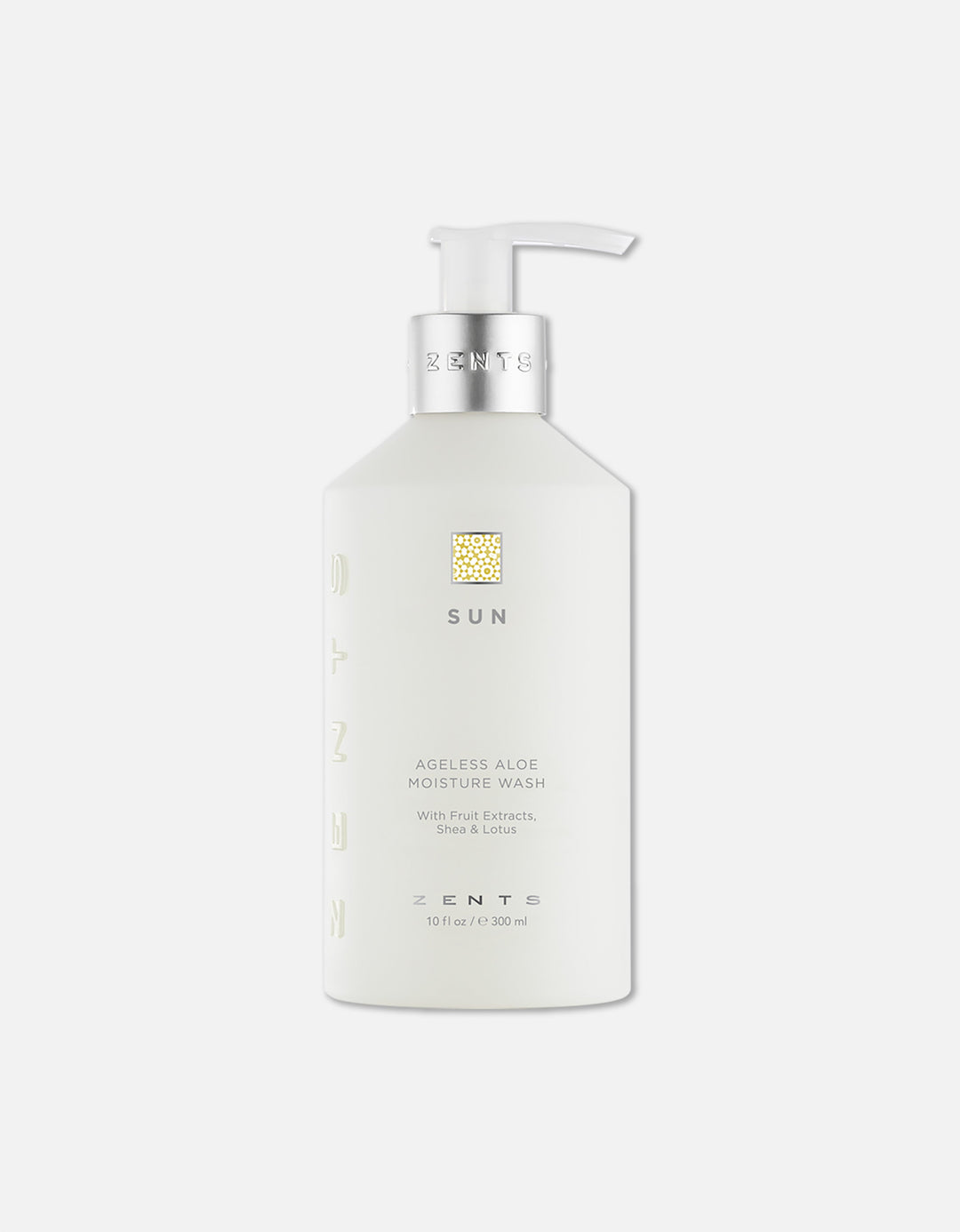
Step into a cool to lukewarm shower (not hot, which compounds the dryness). Apply the Ageless Aloe Moisture Wash to wet skin with your hands. Let it sit for about thirty seconds on the areas that feel warmest. Rinse. Pat almost dry, leaving skin slightly damp, and proceed directly to lotion. The aloe in the wash will have done its calming work. The lotion delivers the moisture. The oil seals it in.
Bottled aloe gel, clean and alcohol-free
After a cool shower and lotion, apply a thin layer of clean aloe gel to specific warm or tight zones. This is a layering step, not a replacement for lotion. A small amount goes a long way. You shouldn't need a thick layer.
Fresh leaf, in a spot moment
Slice off a leaf. Score the surface to expose the inner gel. Run briefly under cool water to clear the latex. Press the cut side directly onto warm skin. Hold for two or three minutes. Don't try to rub the gel in. Let it sit and absorb naturally.
Where the Zents Ageless Aloe Moisture Wash fits in
The Ageless Aloe Moisture Wash is formulated with aloe barbadensis leaf juice high in the ingredient deck, organic plant-based surfactants for a low-foaming, non-stripping cleanse, and added barrier-supportive ingredients like organic shea and lotus. The fragrance is calibrated to be light and clean. The whole product is built around being a gentle, hydrating cleanse rather than a typical drying body wash.
The wash was designed as a daily product, not specifically as an after-sun one. The same things that make it a considered daily cleanse, low-foaming, fragrance-considered, aloe-forward, free of denatured alcohol and harsh detergents, happen to be exactly what post-sun skin asks for in a cleansing step.
For the no-scent option, the Unzented collection line includes a version of the wash with no added fragrance, well-suited to sensitive skin, sunburn recovery, or anyone who prefers their cleansers truly clean of scent. The wash comes in the same eleven scents as the rest of the line, so it can be paired with the matching lotion and oil for a coordinated ritual.
As a daily summer ritual, the routine is simple. Cool shower. Wash. Pat almost dry. Lotion to damp skin. Oil layered on top within thirty seconds. Balm on the high-need zones. The aloe wash does the calming and gentle cleansing. The Age Defying Probiotic Lotion, Luminous Cashmere Body Oil, and Concreta Reparative Balm handle moisture and barrier sealing.
Aloe on an actual sunburn: yes, with care
For a real sunburn (visibly red skin, warmth to the touch, mild pain), aloe is genuinely useful. The caveat is the same caveat that applies to all post-sun aloe use: the product matters more than the marketing.
For a sunburn specifically, choose either a pure aloe leaf application on small areas, or a clean, alcohol-free aloe gel applied gently across burned skin. Avoid any product with alcohol denat. high on the ingredient list. Skip heavily fragranced products on intensely red skin. Avoid anything with menthol or camphor, because the cool feeling those give can sting on actively burned skin.
After the first 24 to 48 hours of acute burn care, transition to your normal aloe routine, wash, lotion, oil, for the remainder of the recovery week. See How to Recover from a Sunburn: A Skin-First Recovery Plan for the complete sunburn protocol, including when to set aloe aside entirely and reach for professional care instead.
Frequently Asked Questions
Is aloe vera really good for sunburns, or is it just a marketing thing?
It's genuinely useful. Clinical research across multiple studies confirms anti-inflammatory effects, faster healing in burn models, and measurable comfort improvement. The marketing concern isn't with aloe itself. It's with products that contain very little actual aloe and a lot of denatured alcohol, fragrance, and dye, and that rely on the cool feeling of the alcohol to imply that the aloe is working. Choose products where aloe is high on the ingredient list and denatured alcohol isn't.
Can I just keep an aloe plant at home and skip the products?
You can, with a few caveats. A small aloe plant is useful for spot treatment of small burns and warm areas. It's impractical for full-body coverage after a real beach day, and the latex layer just under the leaf skin can irritate some people. The most workable approach is to keep a plant for genuine moments and use a well-formulated aloe-based wash or gel for routine post-sun care.
How can I tell if an aloe gel is actually good quality?
Read the ingredient list. A well-formulated aloe gel has aloe barbadensis leaf juice in the top three ingredients (ideally the second), no alcohol denat. in the top half of the list, no synthetic dyes (no FD&C colors), and a short, recognizable ingredient deck. Clean luxury and small-batch aloe gels usually meet these criteria. Drugstore gels usually don't. Price is a rough proxy but not a guarantee. Expensive products can still be poorly formulated.
Should I refrigerate my aloe products?
Refrigerated aloe gel applied to warm sun-exposed skin feels wonderful, and the cool temperature does help cool the surface. But refrigeration isn't necessary for the shelf stability of preserved bottled aloe products. Refrigerated pure aloe leaf gel lasts about a week. Preserved bottled aloe gel lasts months at room temperature. The cool feeling is a comfort benefit, not a safety requirement.
Can I use aloe wash on my face?
Zents formulations are made for bodycare and aren't designed for facial skin. The aloe ingredient itself is fine on the face, but the surfactant blend in a body wash may be too cleansing for the more delicate facial skin barrier. For facial post-sun cleansing, choose a product specifically formulated for facial use. On the body, the Ageless Aloe Moisture Wash is comfortable for all areas including the décolletage, neck, arms, and legs.
Is aloe still useful days after sun exposure, or only immediately?
Useful across the whole recovery window. For a typical day in the sun, that's about 48 to 72 hours. For a real sunburn, longer. Continue daily aloe wash and a light aloe-containing lotion through the recovery period. After day three or four, you can transition back to your normal routine. For ongoing tan-extension or visible-pigmentation recovery, see the dedicated guides on those topics.
The aloe plant earned its place in after-sun care a long time ago, and the place is still real. The shift is just learning to read past the green bottles and the cool sensations, and choosing the format and formulation that actually puts the plant on your skin. Cool shower. An aloe wash that does honest work. The rest of the ritual layered softly on top. Simpler than it looked, and considerably kinder to your skin.